
Remembering 9/11 Attacks 25 Years Later
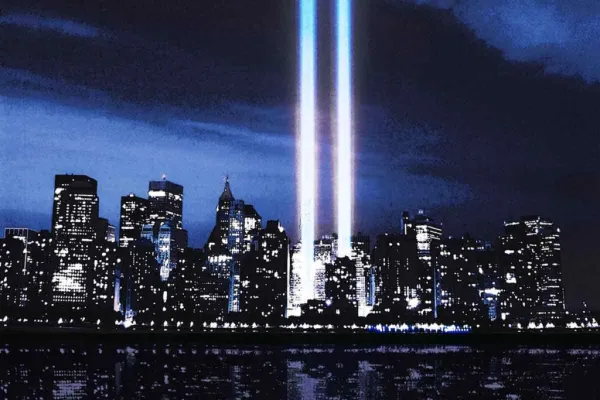
It has been 25 years since the terrorist attacks of September 11, 2001. Many Americans still remember that day with remarkable clarity. According to a recent Pew Research Center survey, 83% of Americans who were born before 2001 remember exactly where they were or what they were doing when they heard the news. Among those who were at least 10 years old at the time, the figure is 93%. Source: Pew Research
I happened to be one of them.
Here is what I remember most.
- I was off work that dreadful morning.
- After having my morning coffee, I checked my messages on my desktop computer.
- I had a voicemail from my older son saying, "Dad, turn on the news!"
- I was glued to the television for several hours, watching in disbelief.
- At the time, I was a 17-year veteran of the Air Force Reserve and the Ohio Air National Guard.
- I began preparing my duffel bag in anticipation of being called to my reserve unit at Rickenbacker Air National Guard Base.
- I made three phone calls after the attacks: one to my reserve unit, one to The Columbus Dispatch, and one to the local CAIR-Ohio office.
- I received a real death threat over the telephone. The caller asked me whether I had bombs at home.
- My wife, a schoolteacher, was brought home early by another teacher because of security concerns.
- My seven-year-old son, Adam, asked me, "What will happen to me if you die in the war?" I told him, "God and Mommy will take care of you."
- I asked my daughter, Nadia, who was the sports editor of her high school newspaper, to go with her best friend to a local mall wearing her hijab and observe the public reaction toward Muslims. She later wrote an article about the experience for her high school newspaper. Everything was normal except for one person who made an obscene gesture as the girls were leaving the parking lot.
- The Columbus Dispatch published a letter from the head of the Columbus Jewish Federation accusing me of supporting suicide bombing.
Those memories remain with me.
But my memories of September 11 do not end there.
The questions that have remained with me
The official account of September 11 is well established: 19 al-Qaeda operatives hijacked four commercial airliners. Two planes struck the World Trade Center towers, one struck the Pentagon, and the fourth crashed in Pennsylvania after passengers fought the hijackers. The 9/11 Commission reported that 2,977 victims were killed in the attacks, excluding the 19 hijackers.
I accept that these events happened. What I continue to question are aspects of the investigation, the intelligence failures, the treatment of certain suspects, and the way some questions surrounding September 11 have been discussed—or dismissed.
Let me first address former President Donald Trump and his 2015 claim that thousands of Muslims in New Jersey celebrated the attacks.
I remember that controversy because it struck a particularly painful chord with me. At a time when Muslim Americans were already facing fear, suspicion and hostility, claims about Muslims celebrating the attacks could have serious consequences.
I believe allegations of this kind should always be supported by reliable evidence, particularly when they concern an entire religious or ethnic community.
My concern is not to excuse the people responsible for September 11. Those responsible should be held accountable. My concern is that innocent Muslims and Arabs should not be blamed for crimes they did not commit.
The five Israeli nationals
One of the most controversial subjects surrounding September 11 concerns five Israeli nationals who were detained after witnesses reported seeing them behaving unusually near a white moving van in New Jersey. The five men have often been referred to in popular accounts as the "dancing Israelis."
According to reports, the men were detained after witnesses said they appeared to be photographing or celebrating the burning World Trade Center. They were subsequently investigated by U.S. authorities and eventually deported to Israel for immigration violations.
Over the years, numerous claims have circulated about the five men, including allegations that they were connected to Israeli intelligence and that their activities demonstrated advance knowledge of the attacks. Those allegations deserve to be distinguished from what has actually been established.
I believe several questions remain legitimate.
What exactly were the men doing that morning?
Why were they photographing the burning towers?
What did investigators determine about their employer and activities?
What did the FBI investigation uncover?
Why were they deported rather than prosecuted for involvement in the attacks?
And what, if anything, did U.S. investigators ultimately determine about possible connections between the men and Israeli intelligence?
These are questions—not proof that the five men participated in September 11. I believe that distinction is important.
The mysterious phone call and the van
Another part of the story concerns reports of a white moving van and a telephone call to police.
According to accounts of the incident, a witness reported seeing men near the van behaving suspiciously while the World Trade Center was burning. Police subsequently stopped the van and detained several Israeli nationals.
Some accounts have claimed that another caller reported suspicious men in a van and that the call may have been intended to misdirect police.
That raises a question for me: Who made the call, what exactly did the caller report, and what did investigators conclude about it?
I have seen claims that the men told investigators, "We are not your problem; the Palestinians are your problem," and that they said they were there to document the event.
If those statements were actually made, I would like to know the circumstances in which they were made and what investigators concluded from them.
And if they were not made, that should be made equally clear. That is what transparency means.
Government secrecy and public trust
Americans deserve transparency when allegations involve terrorism, intelligence agencies and national security.
That is particularly true when the government releases extensive information about some suspects while withholding information about others for national-security reasons.
I therefore continue to ask: What happened during the investigation of the five Israeli nationals? What did the FBI know? What information remains classified? And why?
I do not claim that every unanswered question proves a conspiracy. I do believe, however, that unanswered questions deserve answers.
That is particularly important because public confidence in government has declined dramatically. A Gallup poll reported in September 2026 found that nearly 90% of Americans believe corruption is widespread throughout the U.S. government—the highest level recorded in the poll's history.
That does not prove that the government is hiding the truth about September 11.
It does, however, demonstrate why transparency matters.
Some questions I still cannot reconcile
Unless someone can satisfactorily explain the following questions, I remain unwilling to accept every aspect of the September 11 narrative without scrutiny:
- Why was a passport belonging to alleged hijacker Satam al-Suqami reportedly recovered near Ground Zero when so much of the surrounding material was destroyed? The 9/11 Commission reported that a passerby recovered the passport shortly before the towers collapsed. 9
9/11 Commission
- Why did World Trade Center Building 7 collapse even though no airplane struck it?
- Why has there been so much controversy over the collapse of Building 7?
- What exactly did Benjamin Netanyahu mean when he initially described the September 11 attacks as "very good" for Israel-U.S. relations before qualifying the remark by saying they would generate sympathy for Israel?
- https://x.com/hippyygoat/status/1960773459291553916?s=20
- I
International Center for 9/11 Justice
- Why was Larry Silverstein, the leaseholder of the World Trade Center complex, absent from his usual morning breakfast routine on September 11?
- Why did Silverstein acquire a 99-year lease for much of the World Trade Center shortly before the attacks and subsequently have terrorism coverage as part of the property's insurance?
- What information did U.S. investigators obtain concerning the five Israeli nationals detained in New Jersey?
- Why have some records concerning that investigation remained unavailable to the public?
These questions do not constitute proof of an alternative explanation for September 11. They are questions that I believe deserve careful, evidence-based examination.
What about Building 7?
Building 7 is particularly important to me because it has become one of the most debated aspects of September 11.
I originally referred to it as an 80-story building. That was incorrect. WTC 7 was a 47-story building.
The National Institute of Standards and Technology conducted an extensive investigation and concluded that uncontrolled fires, following debris damage from the collapse of WTC 1, caused a sequence of structural failures that led to the building's progressive collapse. NIST also concluded that explosives did not cause the collapse.
I recognize that finding.
At the same time, the unusual appearance of the collapse has continued to generate public debate. I believe people should be able to ask questions about Building 7 without automatically being dismissed as irrational or dishonest.
The appropriate response to skepticism is evidence.
Where I stand
I want to make something very clear.
I do not believe that Muslims or Arabs as a people were responsible for September 11.
That does not mean I deny that Muslim extremists committed acts of terrorism. Al-Qaeda claimed responsibility, and the 9/11 Commission documented the role of the 19 hijackers and the broader al-Qaeda organization. 9
My objection is to collective blame.
Millions of Muslim Americans had nothing to do with September 11. They were Americans who suffered, mourned, and feared for their country just as everyone else did.
Pew Research Center's recent research documents how deeply September 11 affected Muslim Americans, including the additional burden many experienced from being singled out for suspicion because of the attacks. P
That is why this subject remains personal to me.
Vouching for my loyalty and patriotism
My own experience after September 11 also deserves to be remembered.
I was accused in The Columbus Dispatch of supporting suicide bombing.
I have never supported terrorism or suicide bombing.
A Jewish professor at Ohio State University, Joe Levine, sent a private letter to The Columbus Dispatch in which he demanded that the newspaper apologize for publishing what he regarded as a smear against me. He shared a copy of that letter with me.
Attorney James Hanson, a Korean War veteran and a good friend who has since passed away, similarly wrote to the Dispatch asking for an apology. He told the newspaper that he had read the letter I had written and that he did not see anything in it supporting or encouraging suicide bombing. I remain grateful to both men.
I am also grateful to Dick Carson, the editorial-page editor of The Columbus Dispatch.
After the FBI visited the Dispatch seeking a copy of my alleged letter supporting suicide bombing, Mr. Carson, as I remember it, told the agent that if the FBI found anything illegal or improper about Mahmoud El-Yousseph, he would "eat his hat" on the steps of Columbus City Hall. Those words have stayed with me.
Not long afterward, I visited the Columbus Dispatch to express my gratitude and took with me a large tray of "Baklava." I was given a tour of the facility, met people whom I had known by name but had never met personally, and received courtesy copies of my published letter and readers' responses.
I was also given copies of photographs of my daughter Nadia from her diving competitions in Central Ohio.
Those experiences meant a great deal to me because they reminded me that disagreements do not have to destroy our humanity.
Twenty-five years later
Twenty-five years after September 11, I still remember the fear of that morning.
I remember the television images.
I remember preparing my military duffel bag.
I remember the telephone calls.
I remember the death threat.
I remember my young son asking what would happen to him if I died.
And I remember the accusation that I supported suicide bombing.
But I also remember Americans who stood by me.
That is the part of September 11 I do not want forgotten.
We can disagree about foreign policy. We can debate intelligence failures. We can question government investigations. We can demand the release of classified information when appropriate. We can investigate controversial events without fear.
But we should also remember the difference between asking questions and declaring guilt without evidence.
Twenty-five years later, I am still asking questions.
I do so not because I hate America, but because I love this country and believe that patriotism should include the courage to demand truth, transparency and justice.
Mahmoud El-Yousseph is a Palestinian American freelance writer and retired U.S. Air Force veteran. He writes about U.S. foreign policy, Middle Eastern affairs and justice.